What is non-revenue water?
Non-revenue water (NRW) is the difference between the volume of water a utility puts into its network and the volume it bills to customers. In Arabic it is usually called الفاقد المائي, and reducing it is often described as تقليل فاقد المياه or water loss reduction.
NRW has three parts. Physical (real) losses are leaks and bursts on mains, service pipes and reservoirs. Commercial (apparent) losses come from meters that under-register, illegal connections and errors in billing data. Unbilled authorized consumption covers water used legitimately but not billed, such as firefighting or network flushing.
Where Jordan stands today
Jordan is one of the most water-scarce countries in the world. The National Water Strategy 2023-2040 puts renewable water at about 61 cubic meters per person per year, and projects a fall to about 35 cubic meters by 2040 if current sources stay unchanged.
According to the Ministry of Water and Irrigation, nationwide water loss fell to 41% in 2026, a reduction of 10.7 percentage points from the 2022 baseline. The annual target is a reduction of 2 percentage points, and the National Water Strategy aims for 25% by 2040.
Why water loss costs Jordan so much
In Jordan, much of the supply is pumped over long distances and up to elevated cities, so every lost cubic meter carries the cost of pumping, treatment and conveyance with it. Energy is one of the sector's highest cost components.
Intermittent supply adds a second problem. When networks are filled and emptied on schedules, pressure swings stress pipes, meters lose accuracy, and it becomes harder to see where water goes. Reducing NRW in these conditions needs measurement first.
Seven steps that reduce non-revenue water
1. Water audit and baseline. Measure production, bulk supply and billed consumption, and verify them in the field with portable ultrasonic flowmeters and pressure loggers.
2. District metered areas. Divide the network into isolated, metered zones so losses can be tracked zone by zone.
3. Pressure management. Use pressure monitoring and control to cut excess night pressure, which drives leakage and bursts.
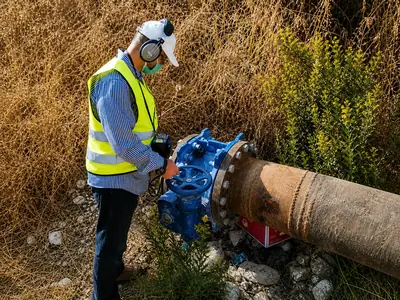
4. Active leak detection. Find hidden leaks with acoustic listening surveys, ground microphones and leak noise correlators, then pinpoint them before excavation.
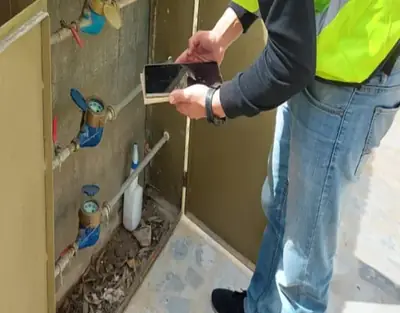
5. Metering accuracy. Test and replace inaccurate customer and bulk meters, and size meters to real consumption.
6. Customer surveys and billing data. Survey connections in the field, find unbilled and illegal use, and correct the customer database.
7. Contracts and capacity. Performance-based contracts and staff training keep results in place after the first gains.
What we have learned on Jordan's networks
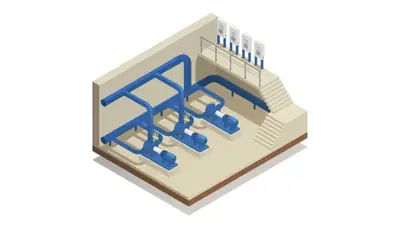
On the first NRW performance-based contract in Jordan, more than 30,000 aging domestic meters were replaced and more than 15 DMA chambers refurbished, improving bulk metering accuracy and reducing apparent losses.
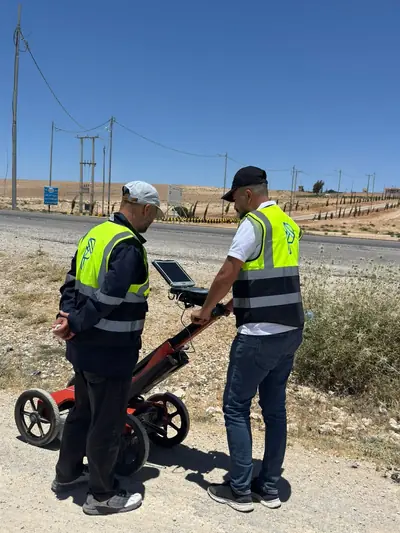
In Marj Al-Hamam and Naor, more than 45 DMAs were established and verified with GPR, correlators, pressure loggers and pipe tracers. On the Lajjoun-Ghwair transmission pipeline, acoustic and GPR surveys identified invisible leaks and potential illegal connections along about 20 km of pipe.
The common lesson is that reliable field data comes first. Programs that start with a measured baseline and verified DMA boundaries deliver results that can be proven and sustained.