
GPR survey services in Jordan
GPR survey services in Jordan for utilities, contractors and industrial sites. Our ground penetrating radar services detect metallic and plastic pipes, cables and voids.
Know what is underground before you dig. We detect and map buried pipes, cables and structures with ground penetrating radar and electromagnetic locators.
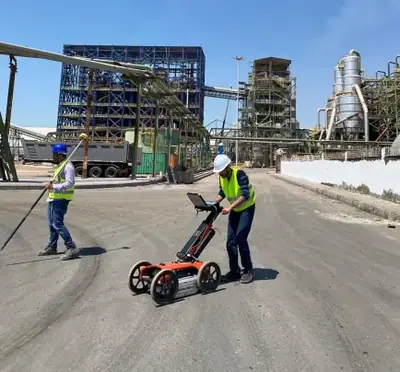
Striking an unknown pipe or cable stops work, endangers crews and disrupts service. Subsurface utility engineering (SUE) removes that risk. Our teams combine ground penetrating radar (GPR), which detects both metallic and non-metallic utilities, with electromagnetic locators that trace metallic pipes and cables along their full route.
We have mapped pre-identified high-risk locations at Arab Potash Company, verified DMA boundaries and interconnections in Amman, Marj Al-Hamam and Tafila, and traced transmission pipelines for condition assessments. Findings are delivered as utility maps and GIS layers with data interpretation and recommendations.
GPR survey services in Jordan for utilities, contractors and industrial sites. Our ground penetrating radar services detect metallic and plastic pipes, cables and voids.
Underground utility detection combines GPR scans with electromagnetic tracing; underground utility mapping in Jordan then delivers drawings and GIS layers.
Underground utility surveys before excavation protect crews and services, and give designers an accurate picture of what is buried.
Underground pipe detection finds water, sewer and service pipes, including non-metallic pipes that only GPR can see: underground utility detection using radar in Jordan.
Pipe and cable locating services with transmitter and receiver: electromagnetic utility locating traces metallic lines and estimates their depth.
We collect existing drawings and records for the site.
GPR scans reveal metallic and non-metallic utilities and structures.
Electromagnetic locators follow pipes and cables and estimate depth.
Results are marked on site and delivered as drawings and GIS layers.
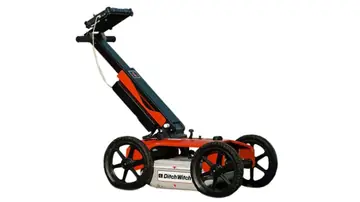
A non-invasive technology that uses radar pulses to detect and map underground utilities, pipes and structures without excavation. In water...
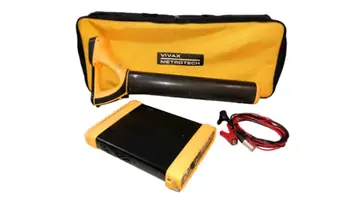
An electromagnetic instrument that detects and traces the path of buried metallic pipes, cables and utilities. It is integrated into subsurface...
A magnetic detector that finds buried or concealed manhole and valve chamber covers under asphalt, soil or debris, so access points can be recovered...
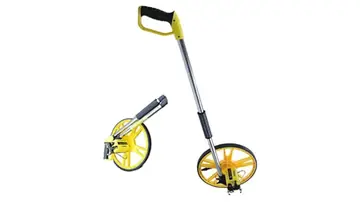
A reliable field instrument for measuring distances along roads, pipelines and infrastructure corridors. It supports site surveys, DMA boundary...
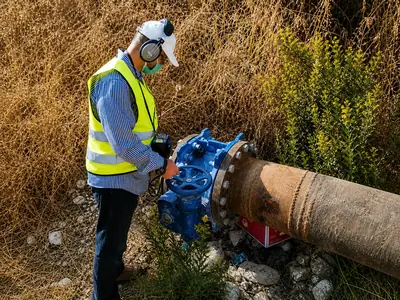
Contracted to establish DMAs under the USAID-funded project to upgrade the Tafila Water System, alongside NRW baselining. The scope included operational assessments and site verification to ensure reliable water supply...
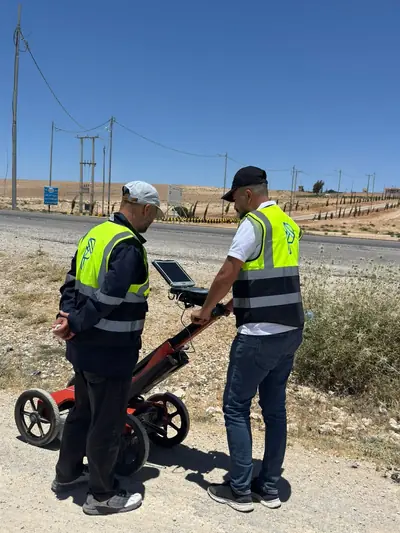
Sub-contracted to conduct condition assessment for Lajjoun-Ghwair Transmission Pipeline (approximately 20 km) including NRW baselining and operational analysis aimed at identification of water losses that represented in...
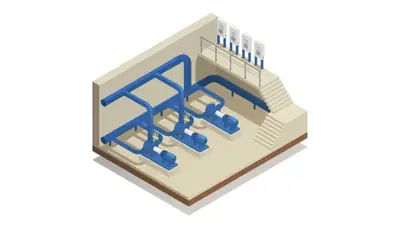
Contracted to establish over 45 District Metered Areas (DMAs) as part of the USAID-funded project for Restructuring Water Supply Networks in Marj Al-Hamam and Naor. The scope of work included conducting operational...
Tasked with conducting site evaluation and subsurface utility engineering for pre-identified high-risk locations at Arab Potash Company, using ground-penetrating radar (GPR) and other set of tracing technologies to map,...
GPR sends radar pulses into the ground and records reflections from buried objects. It detects pipes, cables, voids and structures without excavation, including plastic pipes that electromagnetic locators cannot find.
Subsurface utility engineering (SUE) is the practice of identifying, locating and mapping existing underground utilities and managing the associated risk during design and construction.
Yes. Our teams provide GPR survey services across Jordan for utilities, contractors and industrial facilities, including Arab Potash Company.